BYD bets on dual-electrolyte solid-state battery tech, to start production next year
Every time an automaker promises a holy grail technology that will magically vanish range anxiety, my cynical petrolhead instincts take the better of me. We have been hearing about solid-state batteries for what feels like a lifetime - hyped as the mythical energy density revolution that will give us 1,240 miles road trips without making our cars weigh as much as a small tank.
Then reality knocks on the door - engineers start talking about physical limitations, and battery titan CATL reminds everyone that mass-market production is still years away. And yet, right on cue, BYD revealed a stack of six patents from the State Intellectual Property Office, presenting a surprisingly clever map for how they want to put solid-state tech into our cars.

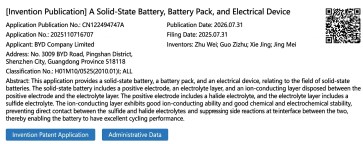
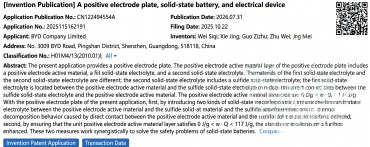
Instead of swinging for the fences with a single magic compound, BYD is playing a game of chemistry speed-dating. The headliner here is a dual-electrolyte cathode strategy. In plain English: they are mixing halide electrolytes - which are great at staying stable - with sulfide electrolytes, which are phenomenal at shuttling lithium ions back and forth at super speeds.
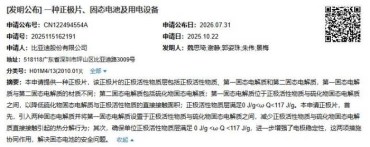
Normally, when you force halides and sulfides into the same room, they act like bitter exes, creating nasty interface resistance and degrading the battery before you even hit your first service interval. BYD's workaround in patent CN122494747A is an ultra-thin, ion-conducting buffer layer sandwiched right between them to keep the peace, preventing unwanted chemical drama and letting the ions flow freely.

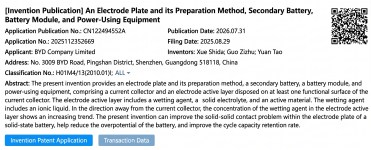
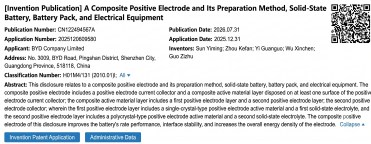
The next patent is the CN122494567A - it tackles the mechanical nightmare of battery expansion and micro-fracturing by building a dual-layer active cathode. The inner layer uses monocrystal structures that resist cracking under the mechanical punishment of repeated charge-discharge cycles.
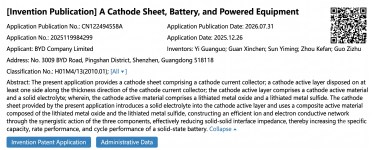
The outer layer uses high-surface-area polycrystals to deliver the heavy-punching rate performance needed when you stomp the right pedal. BYD is even throwing ionic liquid wetting agents into the outer edges of the electrode under patent CN122494552A, effectively grease-jacking the particle interfaces to fix the notorious solid-to-solid contact issue that usually cripples these packs.
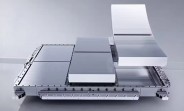
To appreciate why BYD is going through this chemical gymnastics routine, you have to look at their hardware. Most of the latest EVs rely on the famed Blade LFP chemistry - a safe, structural masterpiece, but one that is inherently dense and heavy. If solid-state technology can slash hundreds of kilograms off vehicles and stuff more kilowatt-hours into the floorpan at the same time, it changes the entire dynamic of EV ownership.
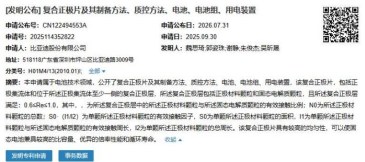
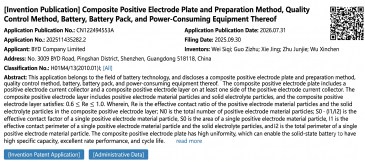
Naturally, solving microscopic chemistry in a lab is only half the battle. The other part is manufacturing thousands of these packs without defect - that's where the real tears are shed. That is why patent CN122494553A introduces a strict quality-control metric called Re, requiring that at least 60% of a cathode particle's perimeter must maintain direct, physical contact with surrounding electrolyte particles.
It turns out that getting tiny solid particles to stick together flawlessly across millions of cells is tough. But by locking down the mathematical ratio during manufacturing, BYD believes it can finally scale production without watching cell capacity drop off a cliff after a few fast-charging sessions.
With all the patents awarded, you'd expect to be pulling up to a dealership next month and buying an EV with solid-state tech. We'll need a little bit more patience - BYD is promising small-scale trial production in 2027, with the first batteries ready for low-volume evaluation in a dedicated EV fleet.

That timeline feels honest. Rival executives dismiss consumer-ready solid-state EV batteries as a distant pipe dream thanks to assembly limitations. But BYD refuses to accept that narrative, and is already building the engineering groundwork to prove the skeptics wrong.
If they pull this off, the days of driving around with huge, dead-weight battery packs just to get respectable highway range might finally be numbered. It won't happen overnight, but watching the world's biggest EV producer crack the solid-state code piece by piece is about as exciting as automotive engineering gets.




From the team behind
GSMArena.com
Facebook
Twitter
Instagram
RSS
Settings
Log in I forgot my password Sign up