This 3-minute charge solid-state tech could realize the true promise of EVs
The dream of owning an EV usually collides with reality at the charging station. Gas-powered vehicles fill up in minutes, but EV drivers need to put up with long waits to recharge their battery packs. This annoying inconvenience is a main reason for many car buyers that puts them off making the switch, but a major technological breakthrough out of Asia might finally eliminate this charging bottleneck entirely.
Researchers at the Chinese Academy of Sciences unveiled a new solid-state lithium-metal battery that changes the rules of speed and storage. This prototype can fully charge and discharge in roughly three minutes. For general drivers, this means stopping for electricity could soon take no longer than a traditional stop at a gasoline pump.
The new battery is great at charging speed, but it also packs a massive amount of power into a small footprint. The research team achieved an energy density of 451.5 Wh/kg. When you compare that to the standard lithium iron phosphate (LFP) cells found in most commercial electric cars today, which hover around 200 Wh/kg, the jump is staggering. This technology effectively doubles the energy storage capacity, promising to significantly extend the driving range of future EVs without adding extra weight to the vehicle frame.
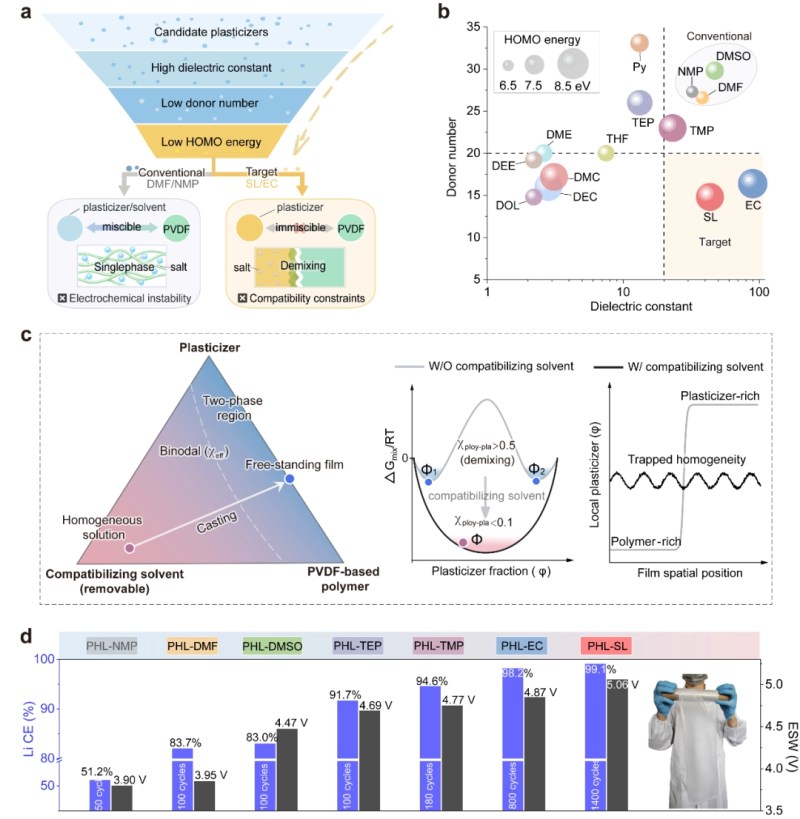 Compatible solvent plasticization strategy expands the range of polymer-plasticizer combinations
The science behind this milestone targets a notorious flaw in solid-state designs. The team focused on an electrolyte material called polyvinylidene fluoride (PVDF) to carry the electrical charge. Typically, the plasticizers used to keep this material flexible break down quickly under high voltage, ruining the battery. The researchers solved this by using a temporary solvent during manufacturing that locks the stabilizing components safely inside the polymer network. This prevents destructive side reactions when the battery operates at high power.
Remarkably, this extreme performance does not destroy the battery after many uses. During testing under intense, rapid-charging conditions, the cell completed 700 continuous cycles while retaining 81.9% of its original capacity. The researchers paired their electrolyte with a high-voltage, high-nickel cathode to prove the system can withstand real-world wear and tear.
Safety is another area where traditional lithium-ion batteries cause anxiety, given their tendency to catch fire when damaged. To test the durability of this new design, the scientists performed a nail-penetration test on a large pouch-cell version of the battery. Even with a metal spike driven completely through its center, the solid-state cell remained stable and did not explode or ignite. This high level of intrinsic safety is crucial for auto manufacturers who must protect passengers during collisions.
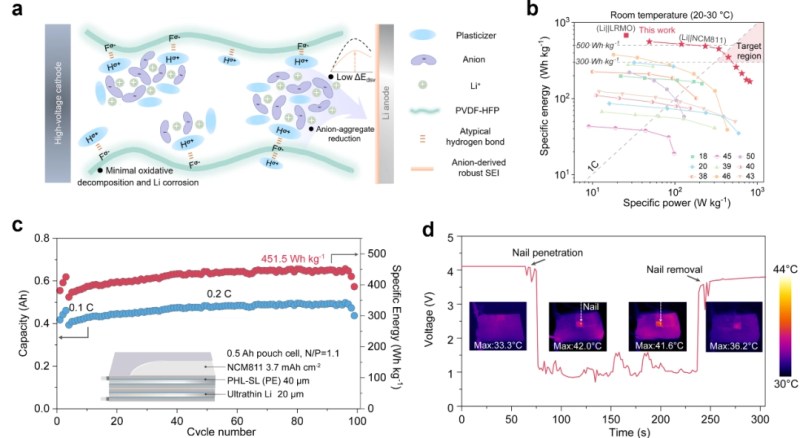 Polymer-modulated anion aggregate solvation structure and solid-state battery performance
This breakthrough is not an isolated laboratory fluke, as several battery heavyweights are racing toward commercial production. Ganfeng Lithium announced that its 400 Wh/kg solid-state cell successfully passed engineering validation after crossing 1,100 cycles, and a startup Pure Lithium has already established an annual production capacity of 500 MWh for its own fire-resistant solid-state variants.
Affordable but heavy LFP chemistry still dominates the EV landscape at the moment. Market data shows that tech giant CATL commands the Chinese LFP sector with a 38.9% market share, supplying 19.53 GWh of batteries. BYD sits in second place with 20.9% share, followed by Gotion High-tech at 8.0%. Mid-sized suppliers like Rept Battero Energy and Zenergy are growing rapidly, posting year-on-year installation gains of 45.6% and 57.9% respectively.
Industry leaders like CATL, Sunwoda, and Farasis Energy have development targets to commercialize solid-state cells between 2026 and 2027. If they can successfully scale their rapid charging cells to mass assembly lines, the automotive landscape will shift forever - electric cars will no longer be the compromise. They will be the obvious choice for convenience.


Reader comments
- zexel802
- xhf
The publication itself is good news. Increased energy density will bring down weight and therefore increase the efficiency. The article on the other hand suggests that current days EV's are not convenient and take forever to charge. Filli...

From the team behind
GSMArena.com
Facebook
Twitter
Instagram
RSS
Settings
Log in I forgot my password Sign up