BYD brings robotic EV chargers to the desert
Liquid-cooled DC charging cables weigh as much as a garden hose filled with wet sand, and trying to twist one into a charge port is nobody's idea of modern luxury. We talk a lot here about battery chemistry and peak charging curves, but the physical act of plugging in a car is at best awkward. Last weekend in the Abu Dhabi desert, BYD showed off its answer to this daily irritation, and while everyone else was staring at the supercars, the real story was right next to them.
BYD flew journalists in from all over the world to watch the Yangwang U9 Xtreme hit a verified production-car record of 312.65 mph on November 6, before revealing the Yangwang Altior ultra-luxury saloon the very next day. With a starting price of RMB 2.08 million - roughly $311,500 - and a global production run capped at 399 units, the Altior is designed to steal headlines. But tucked just off to the side of the main stage was a piece of hardware that will one day affect how normal drivers live with electric cars: an off-grid, solar-fed, 1,000 kW Flash Charging station with a robotic arm.
Watching the system work in the clips shared by BYD France marketing head Michaël Martinez, the sequence is straightforward - you tap a button to activate BYD's Automated Valet Parking, step out of the car, and let the vehicle guide itself into the bay. Once the car stops, a robotic arm uses cameras and force-feedback sensors to locate the charging flap, pop it open, and slide the heavy connector home. When the battery is full, the arm unplugs the cable and stows it away. If you are paying $311,500 for a flagship limousine, not having to scrape your knuckles on a dusty charging plug feels like basic common sense.
Of course, a robotic arm becomes a gimmick when the power delivery behind it is slow. That's where BYD's second-generation Blade Battery comes into play. First introduced in March 2026 together with a charging setup of up to 1,500 kW per connector, this LFP pack can charge from 10% to 70% in five minutes under optimal conditions, or run from 10% to 97% in nine minutes. Even during the desert demonstration, where ambient heat always forces thermal management systems to work overtime, the robotic unit delivered a verified 1,000 kW output. That brings the physical stop down to the exact time it takes to fill a tank of petrol and pay for it.
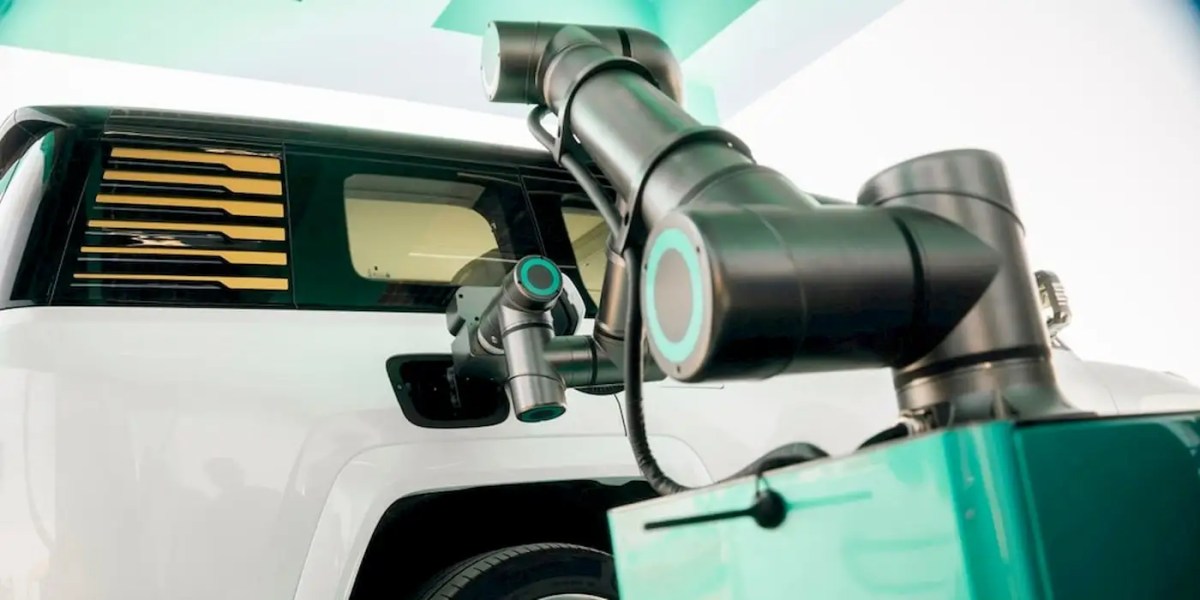
What separates this Abu Dhabi unit from previous high-power prototypes is how the electricity actually gets to the plug. If you try to pull 1,000 kW directly from a standard municipal grid in Manchester, Munich, or Milan, the local substation will either melt or the utility provider will hand you a seven-figure upgrade bill. BYD gets around this with its Solar-Storage-Charging system, which pairs overhead photovoltaic panels with a huge battery buffer built right into the stall. The solar energy simply trickles into the station's buffer battery all day and dumps it into the car at megawatt speeds when needed. It can even run completely off the grid in remote locations.
Back in January 2025, Huawei revealed its own robotic charging arm paired with the Maextro S800, showing the saloon parking itself next to a 600 kW liquid-cooled charger that plugged and unplugged the car automatically. Similar idea, but the difference here is one of industrial scale and vertical integration. Huawei supplies brilliant software, sensors, and power electronics to partner carmakers, but BYD makes the solar panels, the stationary storage cells, the vehicle battery packs, the electric motors, and the robotic arms under one roof. BYD's patent filings show the company has been testing factory automated guided vehicles with these arms for years, even filing designs for depot robots that check tyre pressures, locate valve stems, and inflate tyres while the battery charges.
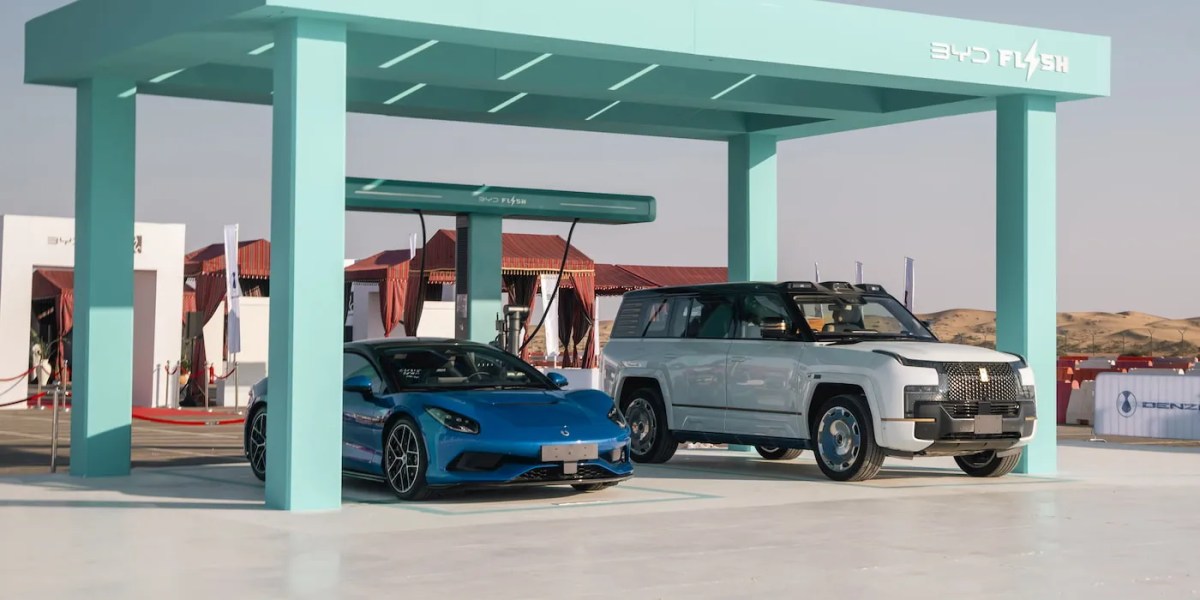
This complete ecosystem brings us back to Wang Chuanfu, BYD's president and CEO, who stood up in 2006 and outlined what he called his Three Green Dreams: capturing solar power, storing it in batteries, and using it to run electric vehicles. Twenty years ago, when BYD was mostly known for making mobile phone batteries and cheap petrol hatchbacks that borrowed heavily from Toyota designs, most Western executives treated that speech as daydreaming. Looking at a self-contained solar megawatt charger sitting in the Middle Eastern sand, it is clear that Wang wasn't pitching a dream - he was reading out a 20-year engineering checklist.
The real test, as always with charging networks, comes down to commercial deployment and whether ordinary drivers will ever see these units outside of a desert press event. BYD has stayed quiet on how much the robotic arm adds to the cost of a stall or when customers can actually use one, and we know all too well that moving mechanical parts in public car parks need relentless maintenance. Regardless, the broader Flash Charging rollout is moving at an aggressive pace. BYD plans to have 20,000 Flash Charging stalls running across China and 100 stations live in Europe before the end of this year, before expanding to 3,000 European locations and 6,000 global stations by the end of 2027. Just to put this in a different light - European and American carmakers are still arguing with utility regulators over grid connections for 350 kW plugs, and BYD is shipping its own solar microgrids and teaching robots to do the heavy lifting.




From the team behind
GSMArena.com
Facebook
Twitter
Instagram
RSS
Settings
Log in I forgot my password Sign up