Toyota swallowed its pride to sell the bZ5 at half the price of Tesla Model Y
In China, the confusing theater of the world's wildest electric vehicle market, logic seems to have gone on holiday. To survive the bruising price war started by the local automakers, Toyota has set its rulebook on fire, rolled up its sleeves, and delivered the refreshed 2027 bZ5 with a price tag that feels like a misprint.
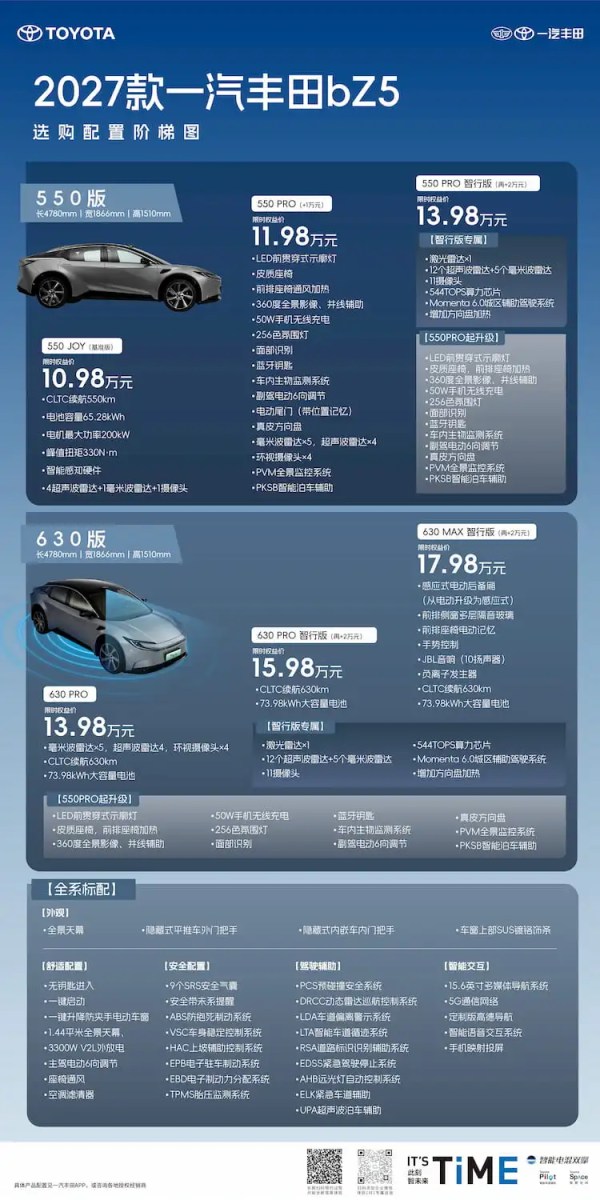
Built under the FAW-Toyota joint venture, the updated five-door electric crossover arrives with a standard sticker price ranging from RMB 129,800 to RMB 199,800 (that is roughly $19,500 to $30,000 on a direct conversion). But because nobody in China pays retail without a fight, early-bird incentives slash the entry point down to a jaw-dropping RMB 109,800 - that's $16,500.
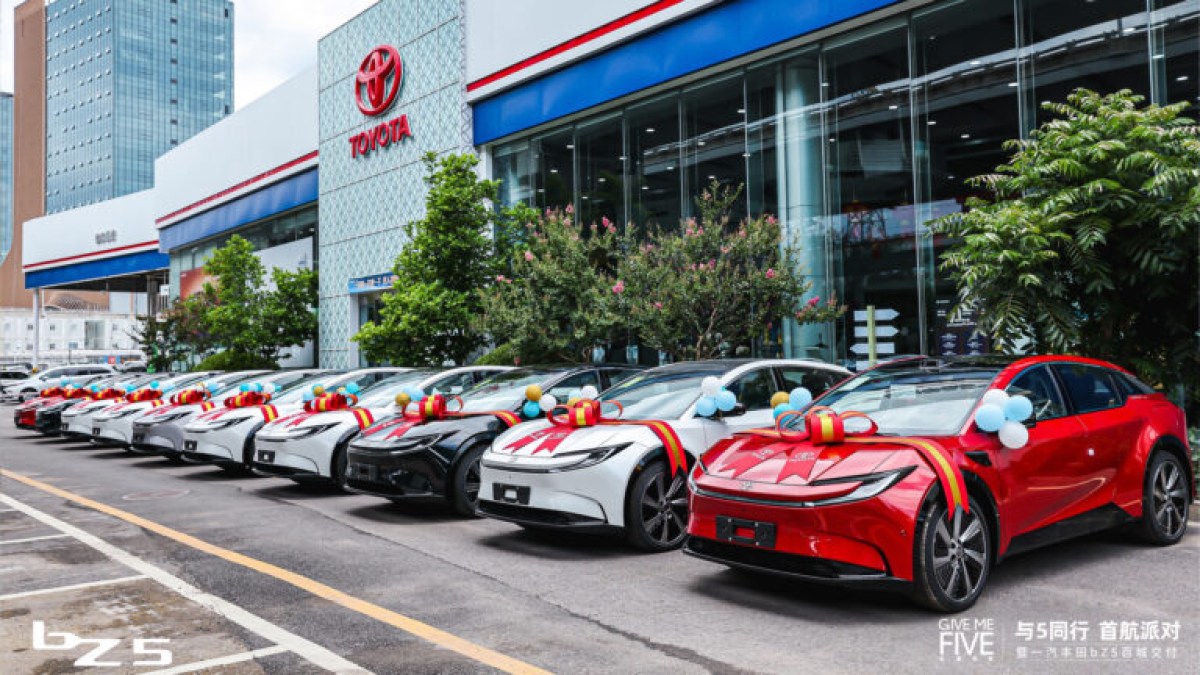
For less than what most Western buyers shell out for a three-cylinder supermini with wind-up rear windows, Toyota will sell you a swoopy, high-riding EV with a roof-mounted LiDAR pod, a clever silicon brain, and a footprint that goes toe-to-toe with the global benchmark.
To appreciate the scale of this pivot, you have to understand the manufacturer's turbulent history with pure electric propulsion. The Japanese titan treated full battery electrics like an annoying distraction from its beloved self-charging hybrids for quite a while. When the mothership finally dipped its toes into the zero-emission waters with the awkwardly christened bZ4X, the launch came with a humiliating string of issues - from loose wheel hubs to notoriously sluggish cold-weather charging curves.
Realizing that its fortress-like brand value meant little to software-hungry Chinese buyers, Toyota swallowed its corporate pride and decided to partner directly with the local automakers, and now it's finally selling its cars in meaningful numbers.
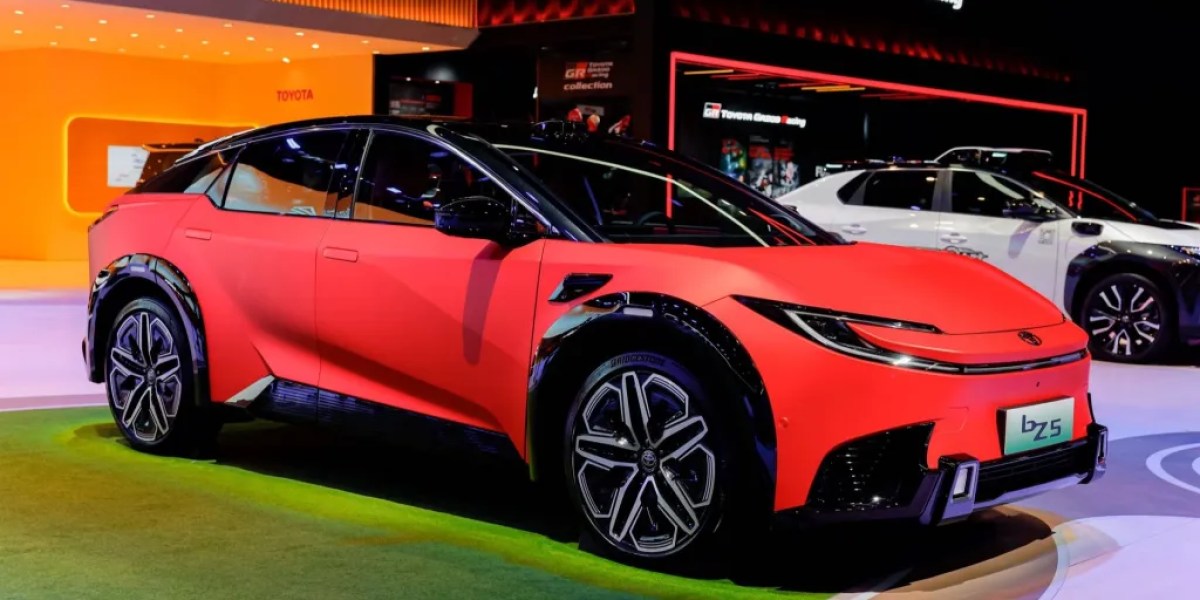
Look past the aggressive hammerhead snout, the razor-thin full-width LED light bar, and that iconic three-oval badge, and you will find that the bZ5's internal organs are overwhelmingly Chinese. The LFP "Blade" battery pack is from BYD's celebrated FinDreams. Buyers can pick between two distinct capacities: a standard 65.28 kWh pack returning a claimed CLTC range of 342 miles, or a meatier 73.98 kWh unit capable of squeezing out up to 391 miles between plug-ins.
When juice runs low, charging from 30% to 80% takes between 27 to 29 minutes on a fast-charging rig - a respectable, if not quite record-breaking, recharge window. Propulsion is handled by a single front-mounted electric motor delivering 268 horsepower (200 kW) and 243 lb-ft of instant torque.
You can't expect neck-snapping acceleration here, and nobody is going to mistake this for a tire-melting monster. Instead, the bZ5 delivers a sweet, linear push that's perfect for everyday driving - confident, effortless torque makes darting through choked-up traffic an absolute breeze, all without giving passengers the dreaded motion sickness.
Where things get interesting is how the bZ5 sizes up against the competition. Stretching 188.2 inches from nose to tail, measuring 73.5 inches across the hips, and riding on a 113.4 inches wheelbase, the bZ5 is surprisingly close to the category's undisputed kingpin, the Tesla Model Y (188.9 inches in length, 75.6 inches in width, 113.8 inches wheelbase). Yet the Tesla starts at RMB 263,500 (around $39,200) in the Middle Kingdom, making the bZ5 literally half the price of a rear-wheel-drive Model Y.
The comparison becomes even more telling when you look at homegrown competitors like the BYD Song L and the Xpeng G6. The sleek Song L is slightly longer at 190.6 inches, but it starts from RMB 189,800. XPeng’s high-tech G6 stands slightly taller at 65 inches with a length of 187.1 inches, a width of 75.6 inches, and an identical 113.8 inches wheelbase. What sets the bZ5 apart from this SUV pack is its ground-hugging profile - standing just 59.4 inches high, it has more of a fastback crossover-coupe silhouette.
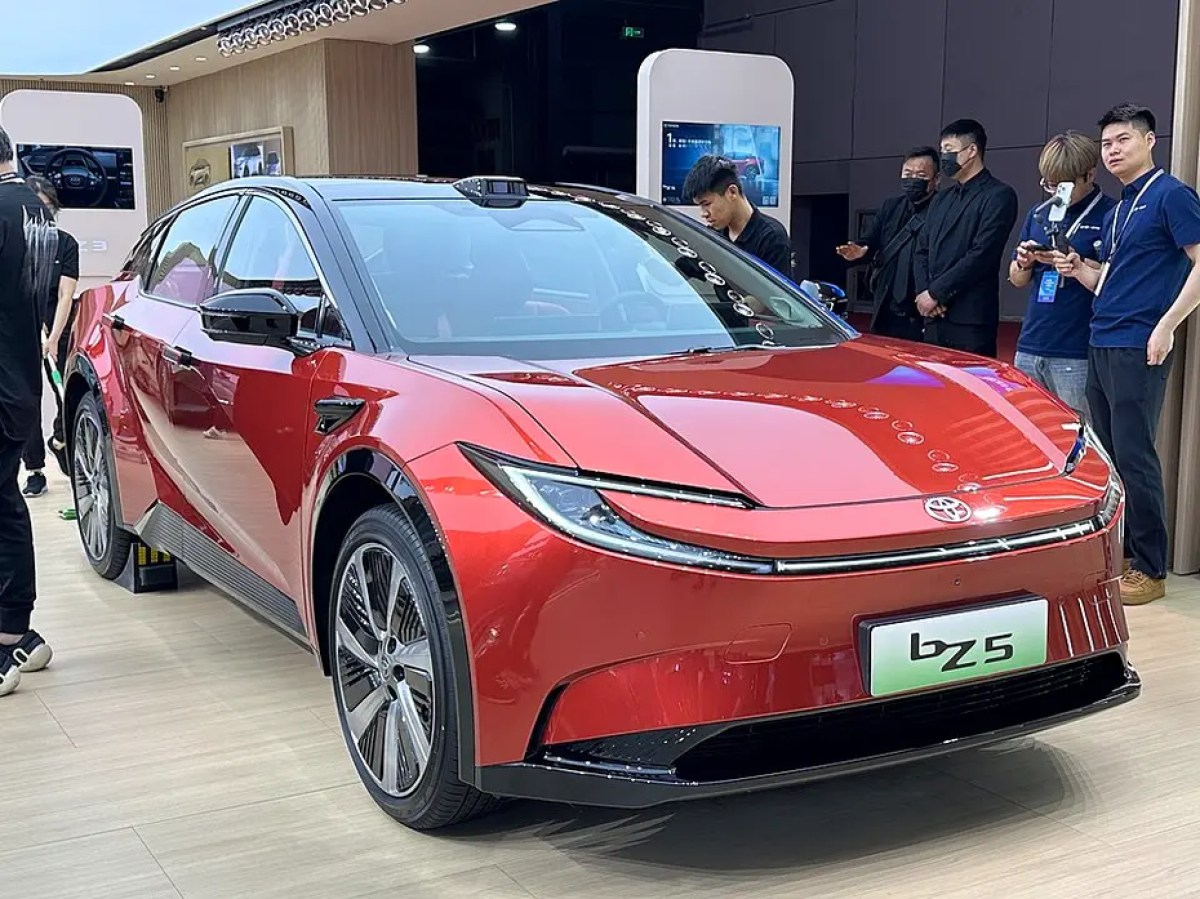
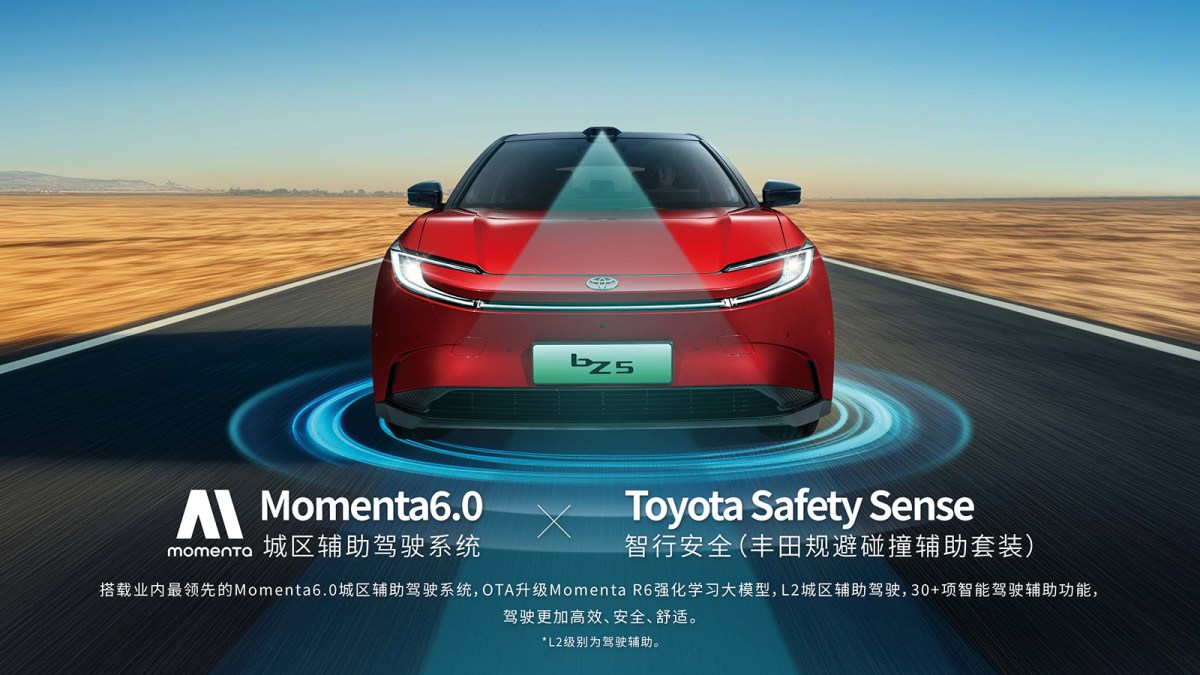
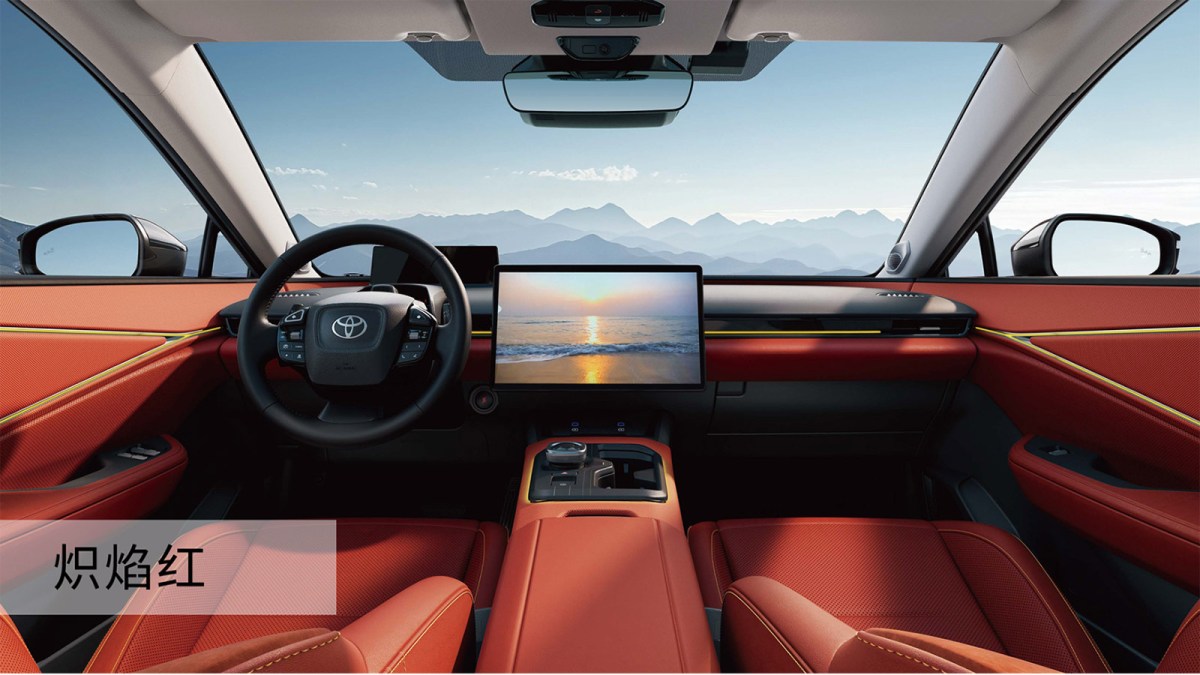
Inside you will not find the sea of utilitarian grey plastics and fiddly analog switchgear that defined generations of sensible Corollas. The cockpit is dominated by a crisp 15.6-inch floating central touchscreen, paired with a minimalist digital instrument cluster and a chunky three-spoke wheel. But the real party piece is hidden deep inside the vehicle's electronic architecture. For the 2027 model year, Toyota upgraded the on-board brain from the older Momenta 5.0 stack to the Momenta 6.0 intelligent driving system.
Underpinned by Momenta's R6 foundation model and backed by a computing platform with 544 TOPS of processing muscle, the bZ5 uses a front-mounted LiDAR unit and an array of 32 smart sensors to navigate the Chinese megacities. It handles end-to-end Navigation on Autopilot (NOA) across urban avenues, tackles tight automated parking routines, and even debuts an industry-first dual Driver Monitoring System (DMS) calibrated to keep tabs on both the driver and the front passenger. It is a surprising amount of top-shelf autonomous kit to find bolted onto a car with a budget price tag.
Yet, despite all this technical flexing and price-chopping, the bZ5 has a brutal uphill sprint ahead of it. In China, price cuts alone no longer guarantee salvation. When the bZ5 first hit dealerships, sales peaked at 3,019 units before literally falling off a cliff. By July, monthly registrations had shrunk to 529 units. In a market where local rivals dish out completely new platforms every twelve months, a legacy badge is no longer a golden ticket.
Toyota's aggressive 2027 refresh is way more than an annual model-year polish - it is an existential defense move. Pairing its manufacturing discipline with BYD's battery chemistry and Momenta's autonomous algorithms, creates a hybrid of Japanese dependability and Chinese tech velocity. Can this cut-price electric crossover claw its way out of the sales doldrums? Watching Toyota take part in the wild race to the bottom is a new experience for sure.


From the team behind
GSMArena.com
Facebook
Twitter
Instagram
RSS
Settings
Log in I forgot my password Sign up