600 Wh/kg energy density is here - almost
Colin Chapman's sacred motorsport gospel - "Simplify, then add lightness" - has taken a proper beating in the electric era. Every time I fling a modern, high-voltage missile into a tight hairpin, I can feel the tortured rubber screaming under the mass of it all. We have built remarkable machines with earth-shattering torque, but the dirty secret beneath every carbon-trimmed EV is that we are dragging a massive, half-ton (if we're lucky) slab of chemical dead weight around.
The culprit is the conventional lithium-ion chemistry. Battery cells relying on graphite anodes are already scraping against their theoretical ceiling of roughly 350 Wh/kg. To extract genuine grand-touring range from that kind of energy density, carmakers have had no choice but to build rolling battleships.
Take the Porsche Taycan GTS - an absolute masterclass in chassis dynamics, but it tips the scales at 5,203 lb when empty. The Tesla Model S Plaid weighs in at 4,802 lb, and the menacing Lotus Emeya slams 5,842 lb onto the road. Even with clever air springs and rear-wheel steering working overtime, you cannot fool physics forever.
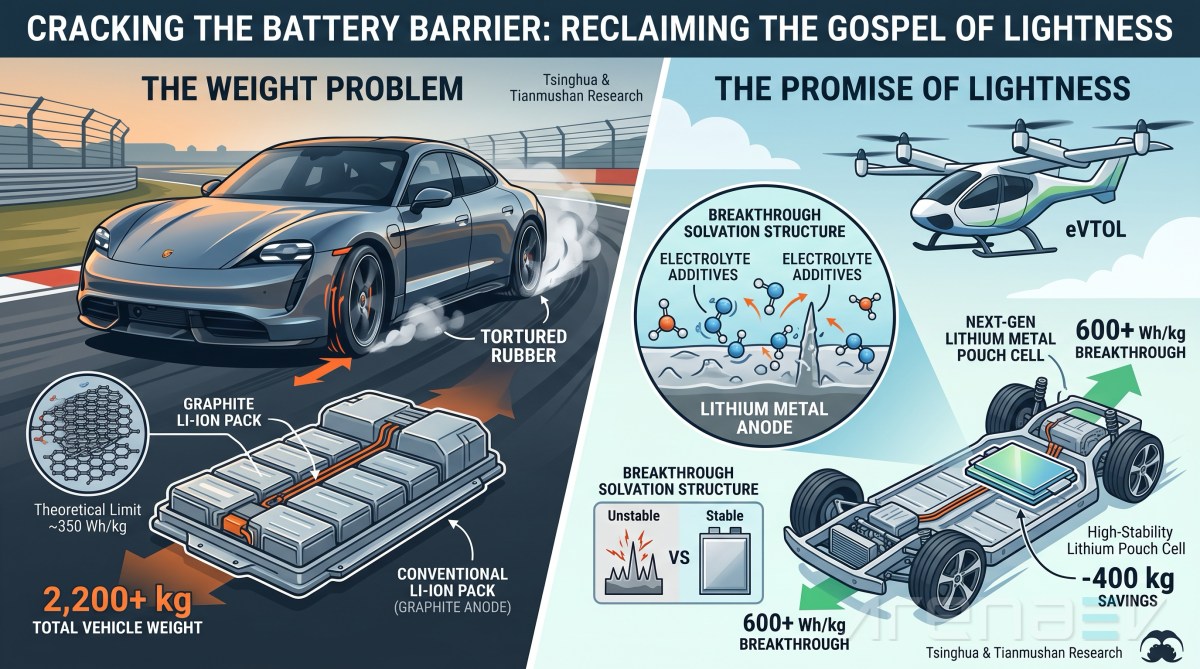
Thankfully, we might have a solution on the horizon. A joint research team from Tianmushan Laboratory and Tsinghua University published a peer-reviewed bombshell in Nature Communications. The researchers have engineered a high-stability lithium metal pouch cell that blows past the magical threshold to hit 602.5 Wh/kg. That is not some modest, fractional improvement squeezed out of packaging tweaks - it is about double the energy density found in the vast majority of electric cars today.
Swapping out the conventional graphite anode for pure lithium metal has been the holy grail of electrochemical dreams. In theory, stripping out the heavy carbon host gives you an astronomical energy boost. In practice, it's a nightmare. Push high voltages through a lithium metal cell, and the liquid electrolyte begins to decompose into an unstable sludge, with microscopic, needle-like spikes called lithium dendrites sprouting from the anode. These crystalline tendrils eventually pierce the separator, short-circuit the cell, and thermal runaway follows - turning your expensive EV into a bonfire.
The breakthrough from Tsinghua and Tianmushan solves this instability at the molecular boundary. Instead of letting the chemistry run wild, the team designed an electrolyte additive that creates an "additive-strong coordination solvation structure". Stripped of the lab-coat jargon, the additive acts like a pair of microscopic bouncers.
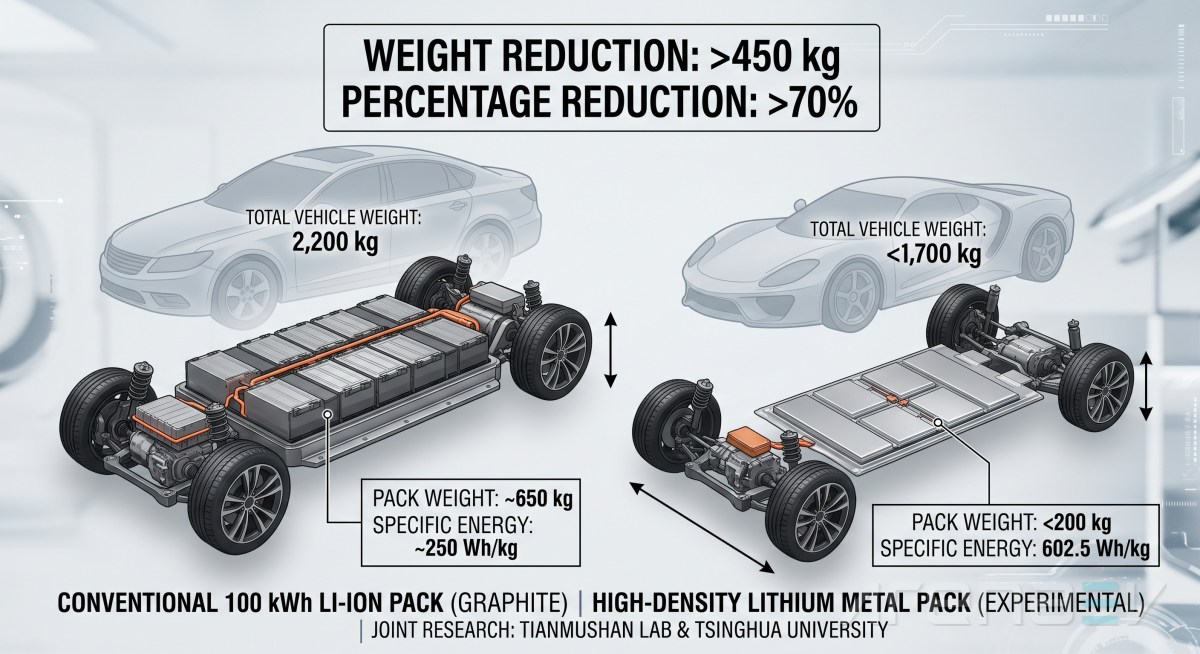
On the cathode side, it deposits a dense, ultra-thin protective film that shields the material from high-voltage degradation. Same time, on the lithium metal anode, it creates a strong solid-electrolyte layer that chokes off dendrite growth before it even starts, speeds up lithium-ion transfer, and fixes safety issues.
The test bench data makes for interesting reading. Using a 10Ah pouch cell configuration with a high-nickel ternary cathode, the cell produced 550.7 Wh/kg while clinging onto 80% of its initial capacity after 180 cycles. When the researchers paired their electrolyte wizardry with a lithium-rich manganese-based cathode, the energy jumped to that headline-grabbing 602.5 Wh/kg - an efficiency leap of more than 50% over mainstream power cells.
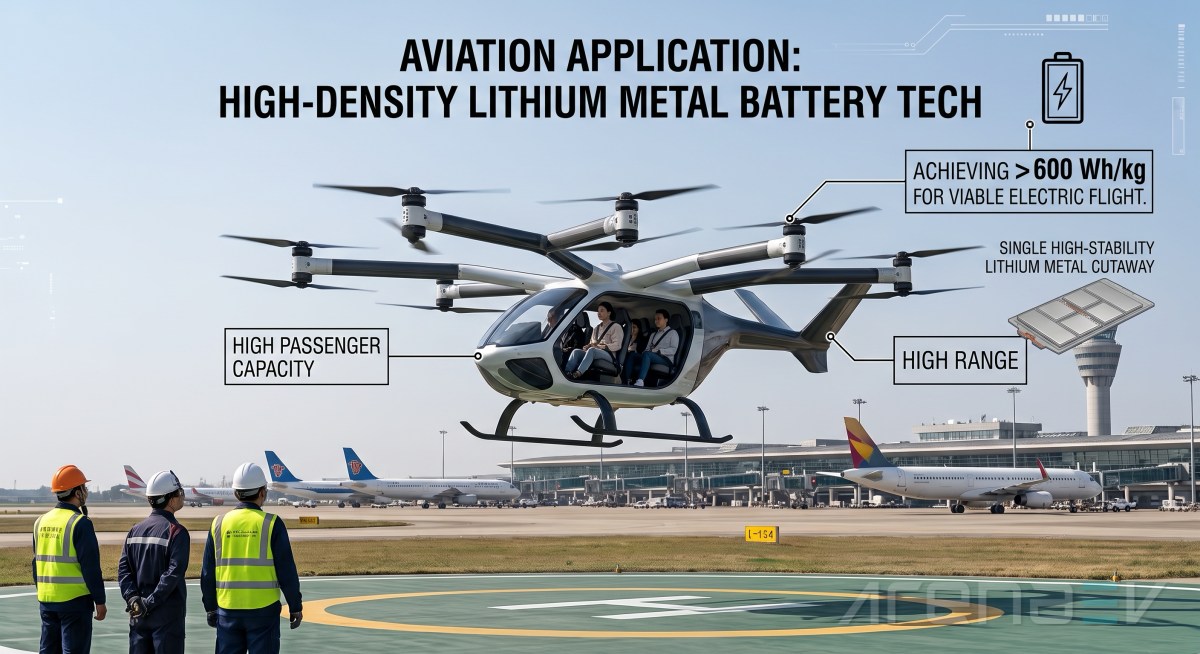
Yet, notice who funded and drove this research: Tianmushan Laboratory, an institution laser-focused on aeronautics and the "low-altitude economy". For all our whining about heavy saloons on twisty backroads, the real desperation for energy density belongs to electric aviation. Electric vertical take-off and landing (eVTOL) craft and long-range commercial drones cannot cheat physics with stiffer anti-roll bars. When an aircraft exhausts its pack, it cannot coast into a service station; it simply falls out of the sky. Carrying a 1,323 lb battery to haul two passengers is a commercial dead-end for airborne mobility.
We have already seen CATL push into this space with condensed matter batteries delivering up to 350 Wh/kg for aviation applications, though the manufacturing costs are astronomical. CATL has floated theories about lithium-air chemistry touching 12,000 Wh/kg - a figure that matches petrol on paper - but that is a distant fantasy. In the real world, 600 Wh/kg is the baseline where electric flight stops being a gimmick and becomes viable mode of transport.
Before we start imagining lightweight, pure-electric track toys hitting showrooms next summer, a chunky dose of reality is in order. Surviving 180 charge cycles to 80% retention in a controlled laboratory pouch cell is a great academic milestone, but it falls miles short of what road transport needs.
Car manufacturers demand battery packs that can safely go through 1,000 to 1,500 abusive, high-power DC fast-charging cycles without a flinch. The chemistry must survive potholes, thermal shocks, and years of neglect. Scaling fluorinated electrolyte additives from lab benches to millions of automotive cells is an industrial problem that hasn't been solved yet.
But if one day this lithium metal architecture eventually finds a way from cleanroom to mass-scale production, the implications for cars are mouth-watering. Imagine slashing the battery mass of a 100 kWh pack from roughly 1,433 lb down to less than 441 lb. We would be back into lightweight performance cars - a 1,500-horsepower Xiaomi SU7 Ultra 882 lb lighter?
Suddenly, an electric sports car could be compact again, and genuinely communicative through the chassis, allowing its electric ponies to go wild without vaporizing brake pads in three hot laps. We might finally see electric cars that don't need four-figure horsepower figures just to mask their own obesity.


From the team behind
GSMArena.com
Facebook
Twitter
Instagram
RSS
Settings
Log in I forgot my password Sign up